|
DOMESTIC TOURISM |
 l Hasa is one of the largest oases in the Kingdom of Saudi
Arabia, with around 30,000 acres (12,000 hectares) of palm groves
and other crops under cultivation. So important has it been in the
history of Arabia that until recent times, the Eastern Province was
known simply as Al Hasa. The name Al Hasa means drinking, and it is
so named for the waters of innumerable little streams and rills that
flow throughout the region. Al Hasa was an obvious place for man to
settle and some of the earliest traces of civilisation in the
peninsula have been found there, in the settlements of the Al 'Ubaid
period, seven thousand years ago.
l Hasa is one of the largest oases in the Kingdom of Saudi
Arabia, with around 30,000 acres (12,000 hectares) of palm groves
and other crops under cultivation. So important has it been in the
history of Arabia that until recent times, the Eastern Province was
known simply as Al Hasa. The name Al Hasa means drinking, and it is
so named for the waters of innumerable little streams and rills that
flow throughout the region. Al Hasa was an obvious place for man to
settle and some of the earliest traces of civilisation in the
peninsula have been found there, in the settlements of the Al 'Ubaid
period, seven thousand years ago.
A weekend getaway
 Where
do most of the inhabitants of Riyadh head for when they want to
escape the heat and smog of the city? Why, the desert of course! But
not my wife and I. 'How about a weekend away from the big city,
getting back to nature and experiencing life in the rough?' I
suggested. 'Sure,' my wife agreed, 'as long as the hotel is
air-conditioned, there's decent coffee and I can go shopping.' So we
didn't exactly end up in the wilds, as I had wanted, but our
compromise location turned out very well indeed.
Where
do most of the inhabitants of Riyadh head for when they want to
escape the heat and smog of the city? Why, the desert of course! But
not my wife and I. 'How about a weekend away from the big city,
getting back to nature and experiencing life in the rough?' I
suggested. 'Sure,' my wife agreed, 'as long as the hotel is
air-conditioned, there's decent coffee and I can go shopping.' So we
didn't exactly end up in the wilds, as I had wanted, but our
compromise location turned out very well indeed.
Three and a half hours' drive from Riyadh
In the middle of Al Hasa oasis lies the town of Hofuf, which has around 22,000 inhabitants and is a trade centre for wheat, dates and fruit. It is only three and a half hours' drive from Riyadh, but light-years away from the traffic and high-rise modern buildings. Our plans for the weekend were straightforward. My wife and I had decided to stay a couple of nights in the Hofuf Hotel, taking in the sights of the town and driving out to surrounding places of interest. It is possible to catch the train from Riyadh, but once in Hofuf, some form of transport is necessary to make the most of the oasis area, so we opted for the drive. We arrived quite late on Wednesday evening, so Thursday morning was scheduled for a casual stroll downtown, before setting off in search of the nearby Ghar Al-Hashshab caves at Jebel Qara.
Bright reds, blues and pinks
Hofuf has grown considerably in the last few years, but still preserves some vestiges of its past. While new buildings in Hofuf proliferate, many of them are concentrated around the outskirts of the old town, where development is rapid. A taste for colourful villas is particularly noticeable and the bright reds, blues and pinks chosen by today's householders form a striking contrast to the subdued colours of the old districts. Trees are being planted along the dual carriageways and sculptures adorn roundabouts and central reservations in the motorway.
Qasr Ibrahim
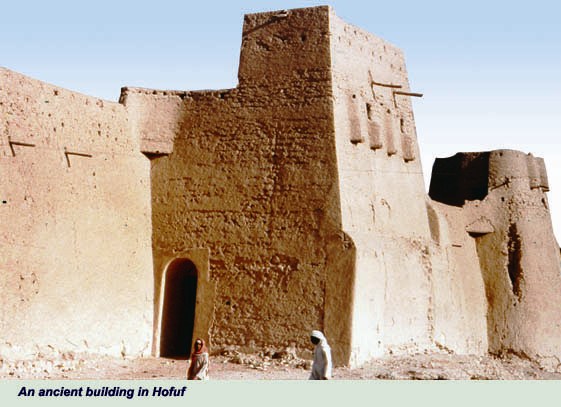
 Luckily,
for those wishing to learn a little more about the town's past, many
of its ancient buildings, including the great forts of Hofuf which
played such a major role in the events of past centuries, have been
preserved. A short walk from our hotel took us to Qasr Kut, or Qasr
Ibrahim, which is an impressive fortification, skirting but not
obscuring a traditional domed mosque dating from the 19th century.
Qasr Ibrahim, with its huge round corner towers, has been renovated
and its white outer plaster renewed. The castle and mosque have
foundations which date back to the sixteenth century, and they have
both been much enlarged over the years. Unfortunately Qasr Ibrahim
was closed for the weekend, so after looking at the fortress, we
headed towards the covered suq and followed the small winding
alleyways that start beyond the back of Qasr Ibrahim. These narrow
twisting thoroughfares pre-date the arrival of the motorcar, and
retain much of the charm of a past age.
Luckily,
for those wishing to learn a little more about the town's past, many
of its ancient buildings, including the great forts of Hofuf which
played such a major role in the events of past centuries, have been
preserved. A short walk from our hotel took us to Qasr Kut, or Qasr
Ibrahim, which is an impressive fortification, skirting but not
obscuring a traditional domed mosque dating from the 19th century.
Qasr Ibrahim, with its huge round corner towers, has been renovated
and its white outer plaster renewed. The castle and mosque have
foundations which date back to the sixteenth century, and they have
both been much enlarged over the years. Unfortunately Qasr Ibrahim
was closed for the weekend, so after looking at the fortress, we
headed towards the covered suq and followed the small winding
alleyways that start beyond the back of Qasr Ibrahim. These narrow
twisting thoroughfares pre-date the arrival of the motorcar, and
retain much of the charm of a past age.
Multi-lobed arches and porticoed doors
The district of Kut is an area of town with a main pathway that meanders back to the road. It is well worth walking its short length to appreciate some of the traditional architecture on either side. The houses are mostly in shades of white, blue, grey and cream, and some have complex decorative features, with multi-lobed arches, porticoed doors and beautifully latticed shutters. Sometimes they arch over the street with the upper floor of a house spanning from one side of the street to the other.
Pottery and woven cloth
 The
main marketplace is quite busy in the morning, but both the suq and
the gold market are much more active in the cooler temperatures of
the evening. You can buy pottery and woven cloth at the suq, or you
can visit the Thursday morning market, when the squares are filled
with sheep, goats and camels which have been brought in from the
farms.
The
main marketplace is quite busy in the morning, but both the suq and
the gold market are much more active in the cooler temperatures of
the evening. You can buy pottery and woven cloth at the suq, or you
can visit the Thursday morning market, when the squares are filled
with sheep, goats and camels which have been brought in from the
farms.
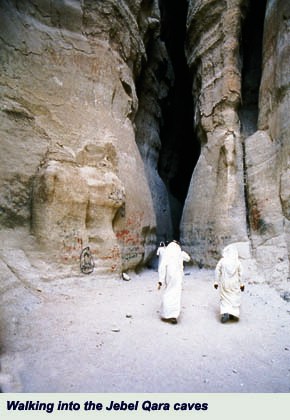
Jebel Qara caves
After having wandered through the town, we decided to venture out to the nearby Ghar Al-Hashshab caves at Jebel Qara. We used the detailed instructions in Desert Treks from Riyadh, by Ionis Thompson in order to find the area, although, once in the vicinity it is impossible to miss, as the road circles the low-lying massif that houses the caves.
Flat-topped, vertical-sided hills
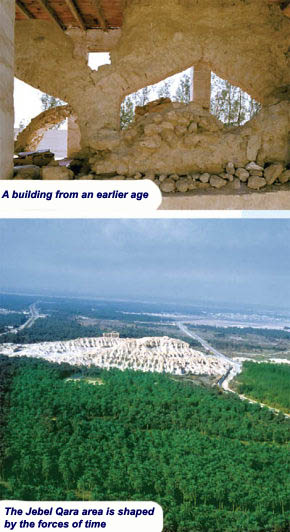
Jebel Qara is a strange area of flat-topped, vertical-sided hills, which have been eroded into weird shapes over the ages, and are cleft with deep gorges. The forces of erosion are such that several caverns are open to the piercing sunlight, but there are also narrow passageways leading into a maze of dark caves where the sun cannot penetrate. Here a welcome coolness reigns, even in midsummer, making the Qara caves a favourite place for family picnics. Even though the whole labyrinth is extensive it is fairly simple to negotiate, with occasional directions, handrails and even aluminium steps to lead you safely around. And, on emerging from the dark, the soft drink stand is a welcome sight.
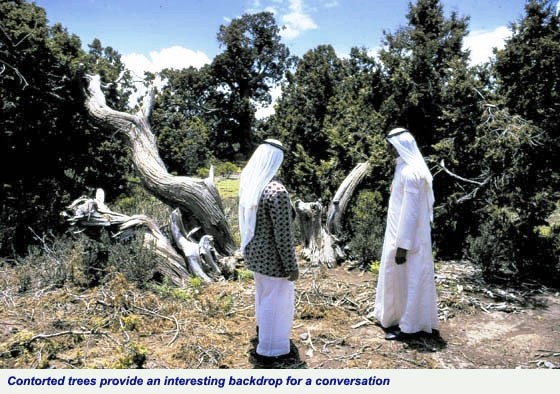
Watering three million palm trees
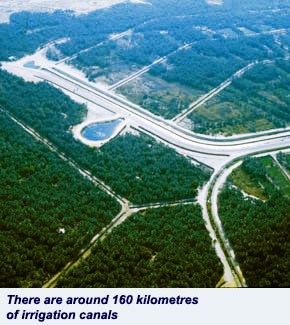
Aside from sightseeing, one of the pleasures for a city dweller is just driving around the lush greenery of the Al Hasa district and enjoying the peace and quiet of the rural surroundings. Water courses are everywhere in Al Hasa, carrying water from more than sixty artesian springs to the roots of over three million palm trees. There are also several hundred wells tapping into the aquifer. The biggest springs produce water at a rate of over one million gallons per hour; substantial canals are needed to carry the flow to more distant farms - so far, around 160 kilometres of irrigation channels and drainage ditches have been constructed.
Relaxed atmosphere
Back in town, even the hustle and bustle of the markets
seemed tame after having previously braved the chaos of Batha in
Riyadh. The relaxed atmosphere further added to our holiday mood. We
dined at the moderately priced hotel buffet and of course, visited
the coffee shop. Room service breakfast was an optional extra that I
can highly recommend. The next morning we ate this, then casting a
final glance around town, set off for the capital. A stress-free
drive and a successful spot of camel photography capped a wonderful
weekend away from the noise and traffic of the big city. I might not
have emulated Wilfred Thesiger, that great explorer; but then again,
he did not get a cappuccino after dinner, or breakfast in bed, so
maybe the compromise was the better option
