|
Nature |
|
Written and photographed by Dr. Graham R Lobley |
||
|
Bee-eaters are among the world's most beautiful and graceful birds. The European bee-eater is a striking multi-coloured avian jewel that migrates across the whole of Arabia. The species also breeds on the Batinah coast of Oman and within the United Arab Emirites. This article takes a closer look at the lifestyles of the four bee-eater species which breed in the Arabian peninsula.
|
||
|
|
||
|
Little Green Bee-eater |
||
The most delightful birds on Earth
For me, bee-eaters certainly rank among the most delightful birds on Earth. They possess startling grace and beauty, as perfectly illustrated by European bee-eaters. They are probably the most colourful and graceful birds to occur in Arabia, effortlessly catching bees and other flying insects, such as dragonflies, butterflies, cicadas and flying ants. They migrate across Arabia in flocks of 25 or more in spring, after wintering in Africa. They often migrate at considerable height, when they can be difficult to see, but can still be detected by their attractive melodic calls. Of the world's 26 recognised species, four now regularly breed in parts of Arabia. One, the little green bee-eater is resident, another, the white-throated bee-eater is purely a summer visitor, while the European and blue-cheeked bee-eaters are both restricted summer visitors, and widespread passage migrants all across Arabia.
Feeding habits
 Bee-eaters
are large headed, long billed and extremely beautiful birds. Facial
patterns are often distinctive, with many species sporting a black
mask (lores and ear-coverts) which makes the bill seem larger and
more formidable. They are aerial insectivores, hunting from open
perches or during longer flights. Typically perching prominently on
fences, telegraph wires, branches or other elevated locations with
good visibility, they give chase to almost all airborne insects up
to a range of 20 metres. All species can eat dangerous insects such
as bees, wasps and hornets, which are rendered harmless beforehand:
the tail and sting of the insect is rubbed against the perch to
discharge the venom and often the sting itself.
Bee-eaters
are large headed, long billed and extremely beautiful birds. Facial
patterns are often distinctive, with many species sporting a black
mask (lores and ear-coverts) which makes the bill seem larger and
more formidable. They are aerial insectivores, hunting from open
perches or during longer flights. Typically perching prominently on
fences, telegraph wires, branches or other elevated locations with
good visibility, they give chase to almost all airborne insects up
to a range of 20 metres. All species can eat dangerous insects such
as bees, wasps and hornets, which are rendered harmless beforehand:
the tail and sting of the insect is rubbed against the perch to
discharge the venom and often the sting itself.
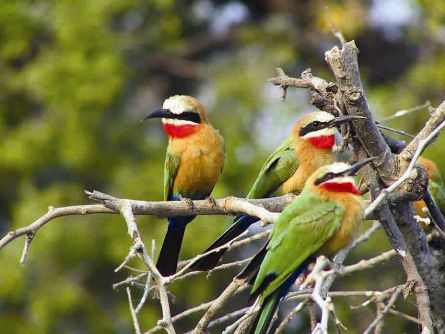
The white-throated bee-eater
 There
is a remarkable contrast between the breeding and wintering habitats
of the white-throated bee eater, Merops albicollis. Its breeding
range is the desert-edge of the Sahel, just south of the Sahara.
Conversely, it winters at the edge of the rainforest zone of the
Congo Basin in tropical Africa. Its breeding range extends in a
narrow band of the Sahel from Mauritania across into the Tihama
coastal plain of western Arabia. In Saudi Arabia, I have
encountered this elegant species at several locations in the Asir
Tihama and foothills, including near Muhayl, Sabya and towards Jabal
Faifa. Typical nest holes are excavated into the bund banks of
millet fields in the Tihama, to which it returns in April from
Africa. In Africa at least, their typical food comprises largely
flying ants. Bees and wasps apparently form only a relatively small
part of their overall diet.
There
is a remarkable contrast between the breeding and wintering habitats
of the white-throated bee eater, Merops albicollis. Its breeding
range is the desert-edge of the Sahel, just south of the Sahara.
Conversely, it winters at the edge of the rainforest zone of the
Congo Basin in tropical Africa. Its breeding range extends in a
narrow band of the Sahel from Mauritania across into the Tihama
coastal plain of western Arabia. In Saudi Arabia, I have
encountered this elegant species at several locations in the Asir
Tihama and foothills, including near Muhayl, Sabya and towards Jabal
Faifa. Typical nest holes are excavated into the bund banks of
millet fields in the Tihama, to which it returns in April from
Africa. In Africa at least, their typical food comprises largely
flying ants. Bees and wasps apparently form only a relatively small
part of their overall diet.
Co-operative breeding
 Several
bee-eaters participate in a process called co-operative breeding,
where non-breeding 'helpers' assist the breeding pair in many tasks,
from excavating the nest chamber to feeding the incubating birds and
the young. White-throated bee-eaters are monogamous and pairs may
have between three to five helpers: the largest number for any
bee-eater. This may perhaps be an adaptation to tougher breeding
conditions in marginal habitats. In Arabia, the numbers that breed
vary greatly from year to year. Studies of another bee-eater in
Nigeria showed the benefits of co-operative breeding in terms of
significantly increased survival rates of nestlings. It was found
that unassisted pairs fledge 78 per cent of their young, whereas
with helpers this can be increased to 95 per cent success. The
breeding adults are also healthier and heavier after breeding with
helpers, who both provide food for the young and also feed the
incubating adults. Many bee-eater species are colonial nesters and
have a remarkably complex society involving clans, in which the
helpers join parents in rearing the young.
Several
bee-eaters participate in a process called co-operative breeding,
where non-breeding 'helpers' assist the breeding pair in many tasks,
from excavating the nest chamber to feeding the incubating birds and
the young. White-throated bee-eaters are monogamous and pairs may
have between three to five helpers: the largest number for any
bee-eater. This may perhaps be an adaptation to tougher breeding
conditions in marginal habitats. In Arabia, the numbers that breed
vary greatly from year to year. Studies of another bee-eater in
Nigeria showed the benefits of co-operative breeding in terms of
significantly increased survival rates of nestlings. It was found
that unassisted pairs fledge 78 per cent of their young, whereas
with helpers this can be increased to 95 per cent success. The
breeding adults are also healthier and heavier after breeding with
helpers, who both provide food for the young and also feed the
incubating adults. Many bee-eater species are colonial nesters and
have a remarkably complex society involving clans, in which the
helpers join parents in rearing the young.
 Another
desert-edge breeding bird, the blue-cheeked bee-eater Merops
persicus is particularly graceful and elegant in flight, because of
its long wings and streamered tail and effortless gliding and
swooping. It is a large, slim bird with bright burnished green
plumage, a black mask, blue cheek stripe and contrasting yellow chin
and red throat. The underwings are conspicuously coppery-coloured.
It is a widespread and common migrant all across Arabia and also
breeds locally in Oman and the northern UAE. Its breeding has been
well documented in Oman, where birds return
Another
desert-edge breeding bird, the blue-cheeked bee-eater Merops
persicus is particularly graceful and elegant in flight, because of
its long wings and streamered tail and effortless gliding and
swooping. It is a large, slim bird with bright burnished green
plumage, a black mask, blue cheek stripe and contrasting yellow chin
and red throat. The underwings are conspicuously coppery-coloured.
It is a widespread and common migrant all across Arabia and also
breeds locally in Oman and the northern UAE. Its breeding has been
well documented in Oman, where birds return
 to
their previous colonial nesting sites in late March. At most
colonies, the one to two metre-long nest is dug horizontally into a
sandy bank, but angled tunnels are sometimes excavated into flat
ground. Hatching of the eggs is timed to coincide with the
appearance of cicadas, thus ensuring an ample food supply. Colonies
may include up to 100 pairs. North of Khaburah, the blue-cheeked
bee-eater breeds abundantly in fields and wadis, usually within five
kilometres of the sea.
to
their previous colonial nesting sites in late March. At most
colonies, the one to two metre-long nest is dug horizontally into a
sandy bank, but angled tunnels are sometimes excavated into flat
ground. Hatching of the eggs is timed to coincide with the
appearance of cicadas, thus ensuring an ample food supply. Colonies
may include up to 100 pairs. North of Khaburah, the blue-cheeked
bee-eater breeds abundantly in fields and wadis, usually within five
kilometres of the sea.
 Khor-Kalba
Within the neighbouring UAE, breeding was first reported in 1989 near Khor Kalba, close to the Oman border. During a visit to this delightful area in April, I managed to see three of the four Arabian bee-eater species in a single day. The blue-cheeked bee-eater likes to forage from telephone wires, but also uses fences and low bushes. Especially in early morning, birds often sunbathe in various positions, the most commonly seen being the 'mantle-ruffle' posture, in which the back feathers are fluffed out.
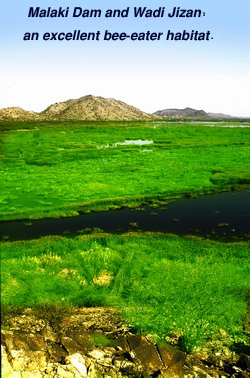
Wadi Jizan and Malaki Dam
One of the most productive locations for birdwatching in Arabia is the Wadi Jizan and Malaki Dam area of southwest Saudi Arabia. In this area, all four Arabian bee-eaters can be seen, two of which breed. The Malaki Dam structure closes a narrow gap where Wadi Jizan passes between rocky foothills; just below the point of confluence of four major wadis. Constructed to provide year-round water for irrigation purposes and for flood control, the reservoir is fed by major wet wadis and has a very large catchment area, extending south into Yemen. In this locality, methods of cultivation, sorghum fields and traditional circular thatched huts present a unique African character. This African 'feel' is also reflected in the region's rich birdlife.
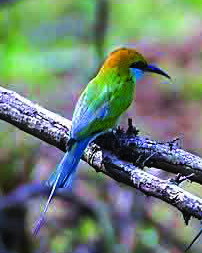
The little green bee-eater
 The
little green bee-eater Merops orientalis ranges from Senegal
eastwards to Vietnam, in various different forms or subspecies. The
Arabian subspecies Merops orientalis cyanophrys is perhaps the most
beautiful, with its bright cerulean blue chin and throat. This
wonderful little bird is a widespread resident in Arabia. It is
particularly special for me, as it was the first bee-eater species I
encountered, following my November arrival in Jeddah
in western Saudi Arabia - after the other three species had already
returned to their African winter quarters. This further kindled my
interest in bee-eaters, and fortunately, it was not too long before
I had seen all the four Arabian species. The little green
bee-eater's habitat includes dry acacia areas and farmland. In
Africa, flying ants are the most commonly reported food. Pairs breed
singly and helpers have not been recorded.
The
little green bee-eater Merops orientalis ranges from Senegal
eastwards to Vietnam, in various different forms or subspecies. The
Arabian subspecies Merops orientalis cyanophrys is perhaps the most
beautiful, with its bright cerulean blue chin and throat. This
wonderful little bird is a widespread resident in Arabia. It is
particularly special for me, as it was the first bee-eater species I
encountered, following my November arrival in Jeddah
in western Saudi Arabia - after the other three species had already
returned to their African winter quarters. This further kindled my
interest in bee-eaters, and fortunately, it was not too long before
I had seen all the four Arabian species. The little green
bee-eater's habitat includes dry acacia areas and farmland. In
Africa, flying ants are the most commonly reported food. Pairs breed
singly and helpers have not been recorded.

The European bee-eater
The European bee-eater Merops apiaster is the most beautiful of the Arabian bee-eaters. With vivid harlequin plumage, it is unmistakable. It is mainly blue-green, with a chestnut head and mantle and a yellow throat. Its vernacular English name reflects a primarily European plus west Asian breeding range, but it also breeds in South Africa's Cape province. It now also breeds sparingly in Oman and the UAE, sometimes in association with the blue-cheeked bee-eaters. A more descriptive name would be golden bee-eater, its local name in the former Soviet Union. Indeed, its distinctive golden-yellow back and rump make it easy to distinguish from all other bee-eater species. Its flight note is a distinctive and melodic liquid and throaty sound. The European bee-eater is a colonial bird and some 20 per cent of the breeding pairs have helpers. It forages mainly by hawking from telegraph wires or dead tree branches, from which two-thirds of its pursuits of aerial insects are normally successful.
Sunny plains and hillsides
Generally regarded as a bird of the Mediterranean, the European bee-eater shows a clear preference for a warm temperate climate, where it inhabits sunny plains and hillsides and also open wooded areas, such as olive groves and cork oak stands. Studies have shown that its northerly breeding range coincides roughly with the 21 degrees centrigrade July isotherm. Consequently, it rarely reaches England, but there have been isolated cases of successful breeding there in recent years, much to the delight of the extremely active bird watching community in that country. In the UAE and Oman, these birds breed together with blue-cheeked bee-eaters, where colonies are sometimes located in old well shafts.

Migration
European bee-eaters pass through Arabia during both their spring
and autumn migrations. In Dhahran in eastern Saudi Arabia, spring
passage extends from late March until mid May, and autumn return
passage from mid August to late September. This migration is
probably mirrored across many parts of Arabia, although the precise
timing is probably a function of latitude and actual migration
paths. So, in many regions, it is possible to enjoy the bee-eater
migration spectacle for at least 12 weeks each year. April is the
best time to see the greatest numbers, which are then also in their
pristine and brightest breeding plumage. Although I have
photographed this species many times over the years, April 2004
provided the best photographic opportunities yet, when I managed to
get images of two birds perched close together, revealing both front
and back views
