|
SPORTS |
|
|
|
Written by Ron Toft
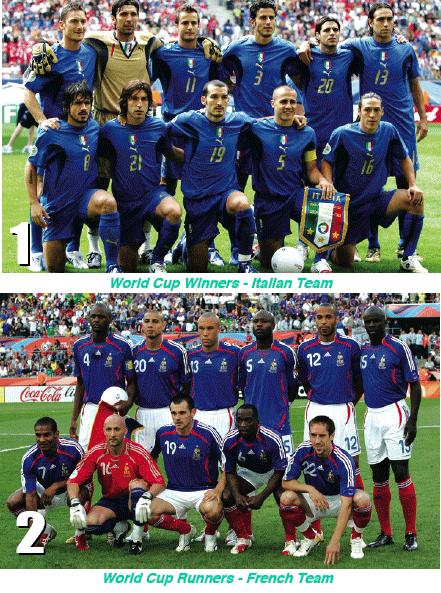
The final was largely lack-lustre, whereby both sides effectively cancelled each other out, finishing 1-1 at the end of normal time. Talented captain Zinedine Zidane put France ahead as early as the seventh minute when he converted a penalty. The winners of the 1998 World Cup did not, however, stay in front for long; Marco Materazzi headed home the equaliser for Italy in the nineteenth minute. That's the way things stayed - at least until the penalty shoot-out. Neither side could find the winning goal during the set 90 minutes or the extra 30 minutes play. To make matters worse, after head-butting Materazzi in the chest, Zidane was given a red card and sent back to the dressing room. Fortune has not always favoured Italy in penalty shoot-outs. This time, however, their collective luck and skill held, each of their five shots being confidently blasted into the back of the net. In the final analysis, the difference between Italy and France was that David Trezeguet of France missed his penalty. Italy cheered, France cried. In the space of just moments, dreams were made and dreams were shattered.
Lippi and Domenech: a coaching perspective
Marcello Lippi, Italy's coach, is quoted as saying on the official FIFA World Cup web site that, 'The further we progressed in this tournament, the more we realised we could win it. Our confidence grew from match to match, especially when we beat Germany in a stadium that couldn't have been more perfect for them". Lippi says he knew that if Italy scored their first penalty, they could score them all. 'Life hands you gifts sometimes and that's how I think of Cannavaro, the best defender in the world, and Buffon, who caused Trezeguet to miss his spot kick. I was sure we were going to win because the players were very motivated by the idea of taking penalties." Raymond Domenech, France's coach, said, 'Being beaten was a huge disappointment. We prepared ourselves to be at our best, the team got stronger and that was all part of the plan. You could see that in how we were a notch above our opponents in extra time. The players now have to remember what they've achieved".
Football's worldwide hum
The 18th FIFA World Cup began long before the June/July Finals in Germany. In fact, there were no fewer than 847 qualifying games. Seven countries - Croatia, France, Holland, Portugal, Saudi Arabia, Serbia and Montenegro and Spain - qualified undefeated. The 32 countries that made it to the Finals were drawn in eight groups of four. There were many surprising results along the way, not least the initial success of unfancied soccer nations Ecuador, Ghana and Ukraine.
The 2006 group results
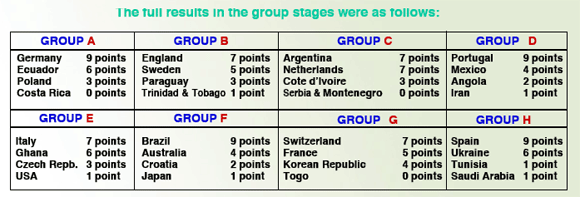
Only two teams in each of the eight groups qualified for the knockout stages of the competition. The group winners were Germany, England, Argentina, Portugal, Italy, Brazil, Switzerland and Spain. Just four of these teams scored maximum points.
Disappointment for Saudi Arabia
Sadly, Saudi Arabia lost twice and drew once in their three group matches. Hence, they failed to progress to the knockout stages. They were hammered 4-0 by Ukraine, beaten 1-0 by Spain and drew 2-2 with Tunisia. FIFA's World Cup web site says Saudi Arabia failed to leave a lasting impression on most fans and that supporters back home were left 'longing for more after the 10-day roller-coaster ride that was their Germany 2006 campaign ended all too soon". Expectations had been modest, 'especially after consecutive defeats in the warm-up games against Belgium, The Czech Republic and Turkey. Yet after being pegged back to 2-2 in the dying minutes of their exciting opening match against Tunisia, Saudi Arabia succeeded in raising a few eyebrows. Yasser Al Kahtani's marvellous strike seemed to herald a return to the kind of form shown by the Saudis at USA 94. However, that performance was to prove no more than a mirage". FIFA says a notable problem was Saudi Arabia's lack of experience. There had also been other setbacks. Mohammed Al Anbar had been forced to withdraw with an ankle injury the night before the opening match against Tunisia and Mohammed Al Shalhoub had to return home prior to the Ukraine match after his mother died suddenly. However, according to FIFA, Saudi Arabia can take heart from the fact that they have up-and-coming players like Yasser Al Kahtani, Mabrouk Zaid and Hamad Al Montashari who, it is hoped, will make their presence felt at the next World Cup. 'Playing in the World Cup has been a great experience for Saudi Arabia", coach Paqueta is quoted as saying on FIFA's World Cup web site. 'It's a wonderful opportunity for the younger players to face strong teams and pick up valuable experience."
The good, the bad and the ugly
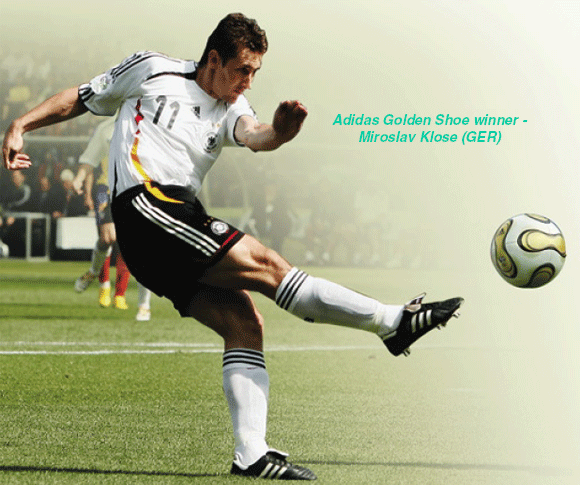
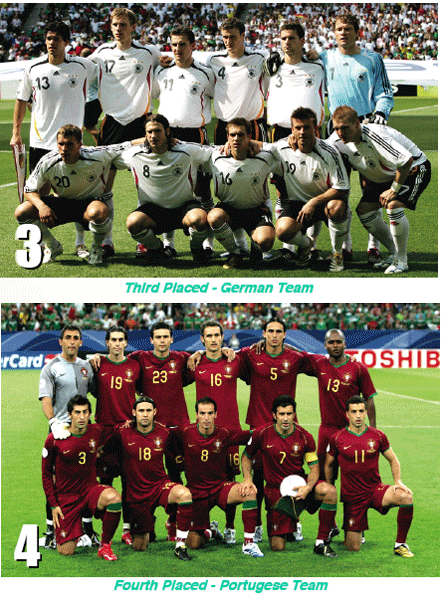
The top players in the 2006 World Cup were Miroslav Klose of Germany with five goals, followed by Hernan Crespo of Argentina, Ronaldo of Brazil and Zinedine Zidane of France with three goals each. The World Cup's top tacklers were Gennaro Gattuso of Italy and Patrick Vieira of France. The best goalkeepers were Gianluigi Buffon of Italy who made 27 saves and Ricardo of Portugal who made 25. The players with the worst disciplinary record, in terms of number of cards received, were Costinha of Portugal and Asamoah Gyan of Ghana, both of whom received one red and four yellow cards. Portugal received 24 yellow and two red cards overall, and Ghana 18 yellow and one red. Despite their poor disciplinary record in the tournament, Portugal nonetheless received the Most Entertaining Team Award presented by Yahoo! Brazil and Spain shared the FIFA Fair Play Award after picking up 886 points each from the 1,000 available. This 'prize' goes to the team with the best record of fair play, sportsmanship and good conduct both on and off the pitch. One of the big surprises of the 2006 World Cup, however, was that neither Brazil nor Argentina made it to the final. Argentina especially was strongly tipped to do well and perhaps even win the coveted trophy itself.
A lack-lustre England
Most pundits agree that England badly under-performed, yet again going out, this time against Portugal. Former England striker Gary Lineker, whose ten goals in the 1986 and 1990 finals makes him the most prolific English scorer in World Cup history, told FIFA's web site that in his view England simply didn't play at all. 'There were a couple of 45-minute spells where they performed reasonably well and looked like they might get it going... but we didn't play to our own strengths. We didn't press people, didn't play the attacking, aggressive football which is what we are all about. In brief, we didn't give ourselves the best chance to succeed."
Looking forward to 2010
For some footballers, the 2006 World Cup
was almost certainly their last major international tournament. For
others, there is still the possibility of achieving national acclaim
and personal glory at the 2010 World Cup in South Africa. Will the
South American sides bounce back in four years' time or will Europe
tighten its grip on the World Cup? Another tantalising possibility
is that, against all the odds, one of the emerging soccer nations
will triumph. Only time will tell. Meanwhile, soccer fans and
soccer players can reflect in the weeks and months ahead not just on
what actually happened during the 2006 World Cup but what might have
happened if events had taken a slightly different turn...
|


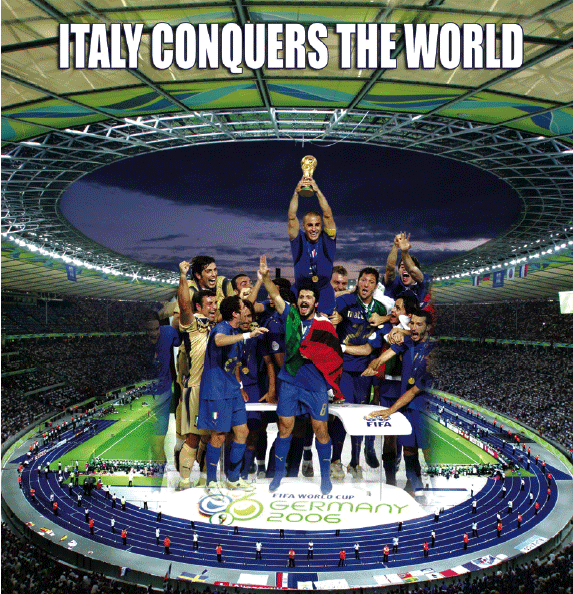
 ike their ancestors of yore, the Italians
of 2006 came, saw and conquered. In this way, they became football
champions of the world for the fourth time, in Berlin's Olympic
Stadium on 9 July, after beating France 5-3 in a nerve-jangling
penalty shoot-out.
ike their ancestors of yore, the Italians
of 2006 came, saw and conquered. In this way, they became football
champions of the world for the fourth time, in Berlin's Olympic
Stadium on 9 July, after beating France 5-3 in a nerve-jangling
penalty shoot-out. 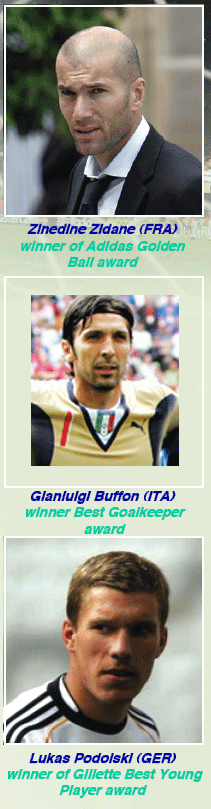 An all-European final
 For four weeks, hundreds of millions of
people globally watched the World Cup on television or on giant
screens in parks and other public places, or listened to matches on
the radio. The relatively few fans who managed to secure tickets to
the matches witnessed the excitement, the colour, the successes and
the failures first hand.
For four weeks, hundreds of millions of
people globally watched the World Cup on television or on giant
screens in parks and other public places, or listened to matches on
the radio. The relatively few fans who managed to secure tickets to
the matches witnessed the excitement, the colour, the successes and
the failures first hand.