|
the eyes of the world will
be on Germany for a month in June and July as 32
nations, including Saudi Arabia, compete for the
coveted FIFA World Cup - the most prestigious of all
football competitions. Furthermore, if the pundits
are to be believed, this 2006 tournament should be
the most exciting and best organised yet; a view
endorsed by Pele in one of his many and recent
interviews.
Attacking play
Attacking, offensive play
is anticipated from many of the teams. "I'm
convinced", said former top player, Lothar Matthaus
in a FIFA news bulletin, "this World Cup will be a
festival of attacking football". Matthaus, who took
part in five successive tournaments, from 1982 to
1998, and helped Germany win the 1990 competition
went on to say: "That's especially true of the top
nations. Jurgen Klinsmann's philosophy is all about
attacking. The Brazilians and Argentinians can't
play defensively and wouldn't even if they were told
to. Lippi's Italy is much more of an attacking side
than they were under Trapatonni, in 2002. But then
you've also got teams like Japan, Sweden, Cote
d'lvoire and a host of others who are committed to
offensive tactics".
Asked if any of the
remaining competitors could stop Brazil from winning
their sixth tournament, Matthaus is quoted as
saying: "Plenty of favourites have fallen in the
last 16. Clearly, anyone looking to lift the trophy
has to deal with Brazil, but even runaway favourites
sometimes lose one-off matches. The Mexicans showed
the way at the Confederations Cup, 2005 and Germany
came within a whisker of doing the same. Brazil
unquestionably have the best individuals, but they
are not invincible".
Even legendary Pele, the
only footballer to have won the World Cup three
times, sounded a note of caution in the same
bulletin: "If you look at World Cup history,
favourites have rarely won the trophy". The
statistics, however, make grim reading for Brazil's
opponents. In World Cup Tournaments over the years,
it has won 60 games, drawn 14 and lost only 13.
Furthermore, it is the only team to have taken part
in every single tournament.
A history spanning over
75 years
The FIFA World Cup has come
a long way since its modest and uncertain beginnings
in 1930. Just 13 countries took part in the
inaugural tournament hosted by Olympic football
champions, Uruguay. Matches took place in
Montevideo, the country's capital, where a
95,000-seat stadium had just been built.
There were no qualification
phases in those early days. Teams were simply
invited to enter the competition. Unfortunately,
only four European nations participated in the 1930
World Cup, this because of the lengthy sea journey
to Uruguay. "Powerful nations like Italy, Germany,
Holland, England and Spain stayed home", according
to the fact and figure-packed Planet World Cup web
site (www.planetworldcup.com),
created and run by soccer aficionado Jan Alsos. "One
of the entrants, Romania, even had their team picked
by his Royal Highness King Carol! However, he would
have little to celebrate in this tournament".
The first ever World Cup
game was held between France and Mexico. The French
won 4-1, Lucien Laurent earning a place in football
history as the scorer of the very first World Cup
goal. The teams that dominated the 1930 competition
were Argentina - still a major force in world
football - and Uruguay. In the semi-finals,
Argentina trounced the United States 6-1. By a
strange coincidence, Uruguay toppled Yugoslavia with
the same score. In the end, Uruguay won the 1930
FIFA World Cup, beating Argentina 4-2.
Only 18 games were played
in the tournament and 70 goals scored. Top scorer
was Guillermo Stabile of Argentina who found the
back of the net eight times. Match attendance was
434,500.
World cup record
breakers
 The FIFA World Cup is held
once every four years, although there was a gap of
12 years, between 1938 and 1950, as a result of
World War II. To date, there have been 17
tournaments. The FIFA World Cup is held
once every four years, although there was a gap of
12 years, between 1938 and 1950, as a result of
World War II. To date, there have been 17
tournaments.
According to Planet World
Cup, Turkey's Hakan Sukur scored the fastest goal in
a World Cup match after just 11 seconds while
playing against South Korea, in 2002. The fastest
hat trick was achieved by Laszlo Kiss of Hungary
against El Salvador, in 1982, when he scored in the
70th, 74th and 77th minutes. He is also in the
record books as the only substitute to score three
times in one match.
Football is essentially a
young man's game, many if not most players retiring
in their early to mid-30s. Roger Milla of Cameroon,
however, became the oldest player to find the back
of the net in a World Cup match when he scored
against Russia, in 1994, at the ripe Ôold' age of 42
years and 39 days! The youngest player to score in a
World Cup match was Pele of Brazil when he shot the
ball past Wales' keeper, in 1958. At the time, he
was just 17 years and 239 days old!
Another of Pele's claims to
football fame is that he is one of only three
players to have scored in two World Cup finals (1958
and 1970), the other marksmen being Vava of Brazil
(1958 and 1962) and Paul Breitner of West Germany
(1974 and 1982). The only player to score four goals
in a match and still end up on the losing side was
Ernst Willimowski of Poland whose team lost against
Brazil, in 1938.
The twists and turns of
qualifying
A staggering 18 million
fans from all over the world avidly followed the
twists and turns of the 847 qualifying matches on
the road to Germany for the 2006 FIFA World Cup.
Seven competing nations - Croatia, France, the
Netherlands, Portugal, Saudi Arabia, Serbia &
Montenegro and Spain - qualified undefeated. Player
Jared Borgetti of Mexico topped the score league
with 14 goals.
What it takes to win
football's most coveted prize
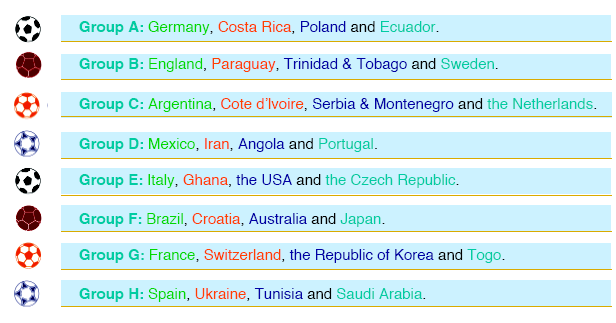
The opening matches of the
18th FIFA World Cup, 2006, will be the group games.
The 32 participating nations have been drawn in
eight groups of four. They are:
Host nation Germany will
play Costa Rica, in Munich, on 9 June, in the
tournament's opening match.
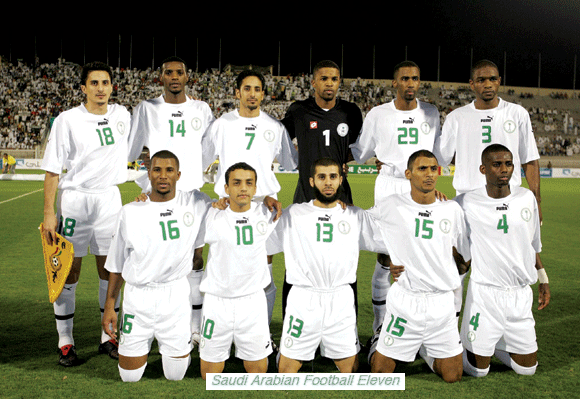
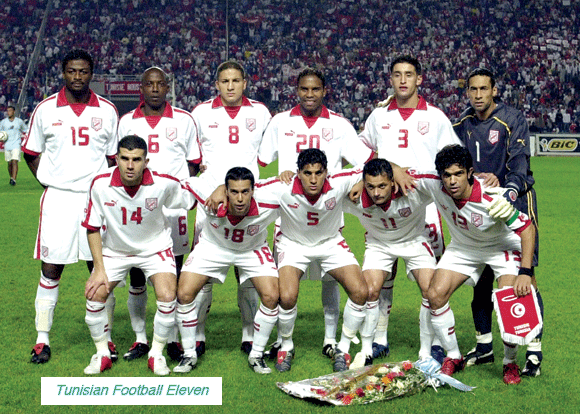
Saudi Arabia's three group
games will be against Tunisia on 14 June, against
Ukraine on 19 June and against Spain on 23 June. The
winner of Group H, Saudi Arabia's group, will play
the runner-up in Group G on 27 June, while the
runner-up in Group H will have to do battle with the
winner of Group G on 26 June. Unless there is a
major upset, which is by no means impossible, France
should win Group G. If Saudi Arabia is to progress
well beyond the group stage, it needs to win Group
H. Coming second would result in Saudi Arabia having
to play France, assuming the latter wins its group.
The semi-finals will take
place on 4 and 5 July and the match to determine
third and fourth places on 8 July. The 64th match of
the 2006 FIFA World Cup will be the final itself, in
Berlin, on 9 July. Will Brazil emerge victorious, as
expected, or will the trophy be winging its way to,
say, Argentina or England? Or will home advantage
result in Germany coming out on top? Only time will
tell.
The nation that wins the
2006 FIFA World Cup, however, will take home the
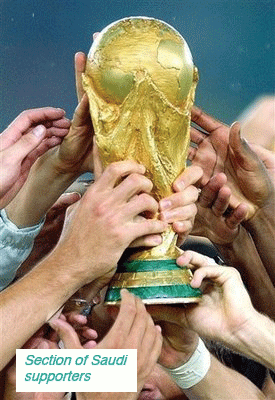
coveted solid gold and malachite trophy made by
Italian sculptor Silvio Gazzaniga and 15.6 million
Euros in prize money. The runner-up will receive
14.6 million Euros. Teams eliminated after the group
stage will receive 3.9 million Euros.
A truly world phenomenon
The modern FIFA World Cup
is a far cry from the tournaments of the 1930s. More
teams are taking part, more fans are attending the
matches or watching them on TV, and there's a lot
more money involved.
No fewer than 3.2 million
tickets have been released for the 64 World Cup
matches; yet 30 million could have been sold,
according to FIFA. At least 9 million fans from
Germany and beyond are expected to view the games
live on giant television screens at the official Fan
Fests in the 12 host cities.
During the last tournament,
in 2002, 300 TV channels beamed 41,100 hours of
World Cup programming to 213 countries. Even more
broadcasters will be involved in 2006. Fans will be
able to access match material not just on TV and
radio but also via the internet and mobile phones.
15,000 people, between them
speaking more than 45 languages, including Hindi,
Japanese and Korean, have been chosen to take part
in the World Cup's volunteer programme. Altogether,
there were a staggering 50,000 applications from 168
countries.
The Saudi Arabian team
base in Bad Nauheim
When looking for team
accommodation in Germany, Saudi Arabia's football
officials plumped for Hotel Dolce in Bad Nauheim,
renewing an acquaintance dating back nearly half a
century. Explained FIFA: "It is 47 years since HM
King Saud Bin Abdulaziz drove through the streets of
the spa town just outside Frankfurt in his sky- blue
Cadillac. Accompanied by a royal entourage, the
Saudi Arabian monarch came to Bad Nauheim, in 1959,
to visit the spas É as did many sovereigns in that
era."
At Hotel Dolce, a prayer
room facing Makkah has been prepared, alcohol has
been removed from the mini bars and the satellite
television has been adapted to receive 35 Arabic
stations. "The finest footballers in Saudi Arabia
should receive the same pampering and regal
treatment on their FIFA World Cup mission as King
Saud did when he visited the spa town", official
sources continued.
A coming together of all
nations
German Chancellor, Dr
Angela Merkel says the 2006 World Cup is a "unique
chance for Germany to present herself as a
welcoming, tolerant and modern country bursting with
ideas. I am convinced that we will witness a
fantastic and joyful festival of football and a warm
coming together of peoples"
|