|
 he
word corniche was originally coined to describe a road on
the side of a mountain or cliff, with the ground rising on
one side of the road and falling away on the other.
Derived from the French route à
corniche or road on a ledge, it was applied to some mountain
roads in the Cote d'Azur in southeast France.
The name was also used on a famous
Rolls Royce model. In the Middle East, corniche typically
describes a waterfront promenade, usually parallelled by a
main road.
In Arabia, the corniche runs along
the coast.
During May 2006, I had a chance to
directly compare the latest corniche developments at these
three locations. he
word corniche was originally coined to describe a road on
the side of a mountain or cliff, with the ground rising on
one side of the road and falling away on the other.
Derived from the French route à
corniche or road on a ledge, it was applied to some mountain
roads in the Cote d'Azur in southeast France.
The name was also used on a famous
Rolls Royce model. In the Middle East, corniche typically
describes a waterfront promenade, usually parallelled by a
main road.
In Arabia, the corniche runs along
the coast.
During May 2006, I had a chance to
directly compare the latest corniche developments at these
three locations.
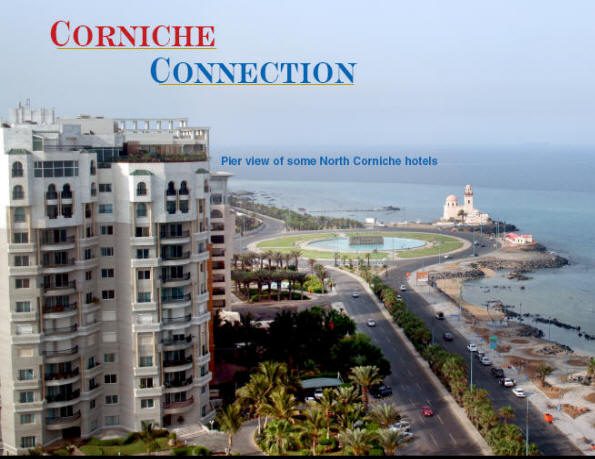
 Jeddah's North Corniche Jeddah's North Corniche
The cosmopolitan city of Jeddah embraces 2,500
years of tradition as Saudi Arabia's most important business
centre. The fashionable and magnificent North Corniche is a
must-see location for any visitor to this vibrant and
invigorating city.
From the outset, the development of
the corniche was directed towards creating an integrated
recreational area.
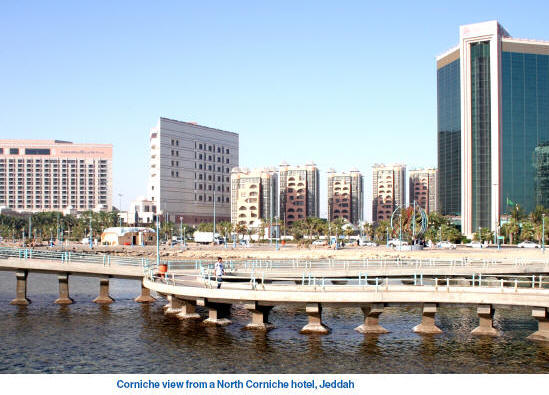
There are several striking features
to this wonderful corniche: sea pools created by loops
described by the road, foot piers to cross the coral reef
and admire the sea and several mosques located by the sea or
on islands.
The North Corniche is certainly a
major showpiece offering many unique attractions.
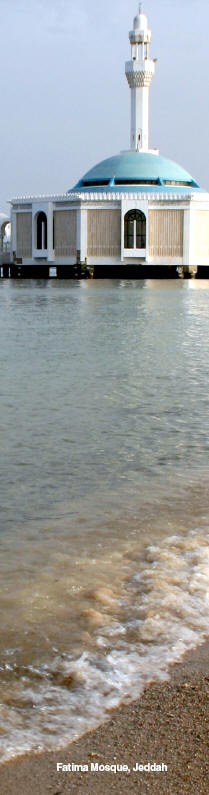
The striking Fatima Mosque, situated
right on the Red Sea, is one of its most beautiful and
impressive sights by day or night.
This unmistakable landmark is
located towards the northern end of the beach.
The North Corniche has been a popular destination
with locals for decades. Families in particular enjoy their
outdoor picnics overlooking the sea after sundown.
There are also now a clutch of
amusement parks, as well as many refreshment stalls and fast
food outlets, plus several restaurants and five star hotels
to choose from.
Some of the new high-rise hotels are
dramatic structures and the top floor restaurants at these
boast impressive, panoramic views of the corniche and Red
Sea.
Additionally, the corniche features
an even more futuristic looking hotel - the Corniche
Rosewood -that claims to be Jeddah's first ultra-luxury
hotel.
In the evening, there is a definite buzz about the
place and it can even become crowded.
Mornings are much quieter, so if you
can stay at one of the hotels, an early morning walk is
rewarding. You might even see a few fishermen, trying their
luck from the piers or by the shoreline.
Sunset is also a wonderful time,
especially in the cooler months, when the skies briefly
transform into a beautiful, almost incandescent, orange glow
at sundown.
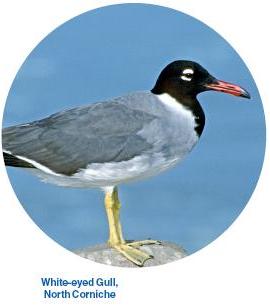
For birdwatchers like myself, early mornings can
also be very productive. Two distinctive gull species, the
White-eyed and Sooty gulls, are easily seen in the early
morning, when they are on the lookout for scraps of food
left by picnickers.
The summer plumaged White-eyed gull
is a very handsome bird indeed.
The relatively small Green-backed
heron is also found here, where it can be seen fishing from
the rocks: on a recent visit, I also saw a pair of these
birds perched on a small boat at the open marina at Sharm
Obhur.
Jeddah is a city of remarkable greenery and flower
beds, which are nothing short of a tribute to the
foresighted municipal authorities.
Beautiful bougainvillea and oleander
are abundant; the latter often planted on the central
reservations of the dual-carriaged corniche road.
Several palms are grown, not least
date and coconut, and these present a distinctly tropical
image.
Obhur Sharm is a wonderful natural bonus: this is
an attractive, relatively narrow creek that extends a few
kilometres inland.
Furthermore, the sharm forms a
perfect natural harbour: there are boat marinas on the south
side and several exclusive developments on the north side.
The chic Al-Sambouk Marina moors
some impressive sea vessels, while on the creek itself, one
can often see small speedboats demonstrating their prowess.
 New developments at Al-Khobar New developments at Al-Khobar
Until very recently the corniches at Al-Khobar and
Dammam did not match Jeddah's. However, these two eastern
cities are now definitely beginning to narrow the gap. The
magnitude and scope of some exciting new developments is
literally amazing.
Al-Khobar's attractive Central
Corniche is already maturing with palms, and a host of shrub
and flower beds.
The new South Corniche is planned on a major
scale.
The Shubaily Grand Mall promises to
be a unique shopping experience, anywhere in Arabia.
Construction of this remarkable
development is already well underway.
Artists' impressions at the mall
construction site show an interesting Arabesque
architectural style, with a lagoon bordering the leading
edge of the mall, which has an island with palm trees on it.
The multiple 'fingers' of the
corniche seafront are already completed and planted with
mature date palms.
The three sets of palms on 'islet'
mounds right by the seashore form an aesthetically
attractive feature that scores top marks for me.
These are especially noticeable upon
returning to the Kingdom on King Fahad Causeway, an
impressive road link between Saudi Arabia and Bahrain. This
palm feature is best appreciated during the very early
morning, with low sunlight rising from the east.
White-cheeked and Saunder's terns are common all
along the shore over summer.
Reef herons and various shore birds
can also be seen on the edges of the finger inlets.
Occasionally, out to sea, it is also
possible to spot large flocks of Socotra cormorant - an
endemic seabird species that is practically restricted to
the Arabian Gulf and the Arabian Sea.
These cormorants nest in large
colonies on selected Gulf islands including Samamik in Saudi
waters and on Bahrain's Hawar Islands, the latter perhaps
the world's largest colony, possibly exceeding 25,000 pairs.
Dammam Corniche and Al-Murjan Island
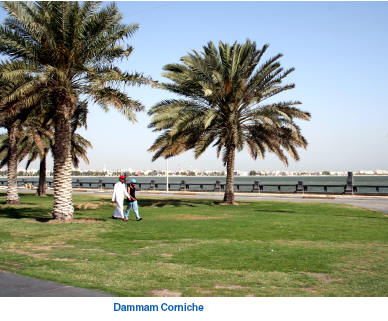
Dammam's Corniche is centred on a wide
semi-circular bay in which Al-Murjan Island has been
constructed.
The original part has a promenade
backed with palms planted on extensive lawns.
More modern additions and
substantial extensions to the corniche are currently
underway. These include various children's theme and
amusement parks, supported by restaurants and fast food
outlets.
In the Gulf, the tidal movement is
large and it is always fascinating to watch the incoming
water and the ever-changing shoreline.
Al-Murjan Island is connected to the northern part
of the bay by a curving causeway.
There are attractive coloured
sunshelters and picnic places, though the area is
practically deserted during the early morning, except for a
few active fishermen,
who seem to enjoy good catches of
small fish, which they say are delicious when grilled.
While talking to them, a handsome
breeding-plumaged Lesser crested tern flew by and
effortlessly caught a fish at close range.
As sea terns and other seabirds are
abundant in the Gulf, even inshore, this underlines the
great biological productivity of this shallow and warm sea.
Which corniche to visit?
This is really an open-ended question, one that
depends on individual preference, as all three now promise
excellent recreational facilities and amenities.
Personally, I still prefer Jeddah's
North Corniche, with its added bonus of the natural creek at
Obhur.
All three have their merits and the
corniche's at Al-Khobar and Dammam are currently being
rapidly upgraded and extended.
|