7 Reasons
Your Kid Needs Sleep
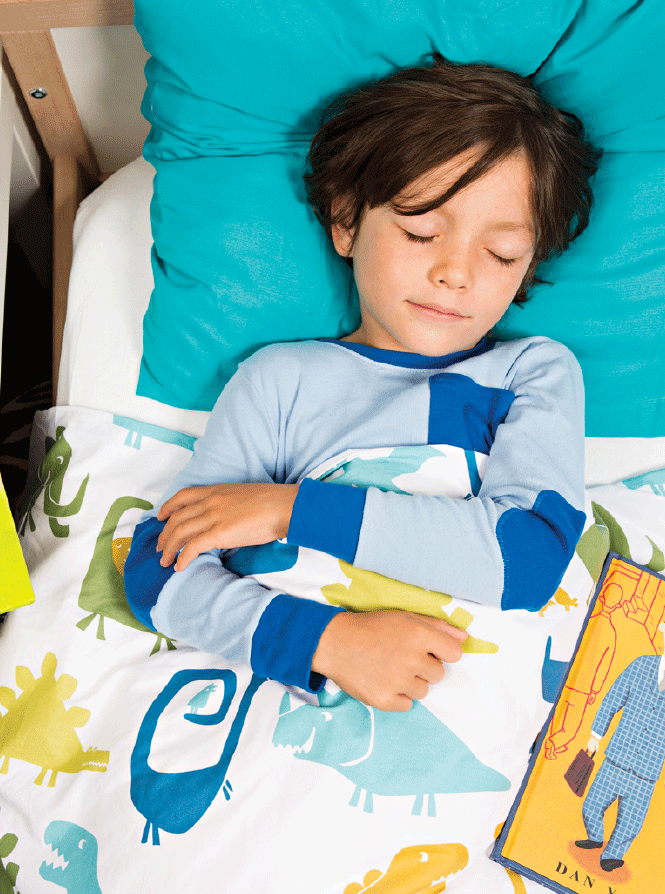 |
New research explains how vitamin ZZZ may help children fight obesity, avoid colds, and succeed in school.
by Sarah Mahoney
photographs by Meiko Takechi Arquillos
Once it’s 7:45 p.m., all is quiet at the Tanaka house in Los Angeles. Presley, 6, James, 4, and Jase, 2, are all sleeping soundly. “My husband and I sleep-trained them at an early age, and our routine is nonnegotiable,” says Caroline, who works from home as a publicist. “They have a bath, brush their teeth, say a prayer, and get a story. Then it’s lights-out. I’m convinced that’s why they have fewer meltdowns. They also don’t get as many colds as other kids in their class.”
The Tanakas are on board with the increasingly urgent public-health mission to help American kids (not to mention their chronically exhausted mothers and fathers) get more sleep. Parents have always felt that sleep directly affects a child’s mood, and most would agree it’s got a big impact on learning and behavior. But pediatric researchers’ latest findings suggest that sleep is also essential to good health. When kids get the sleep they need, they may have a lower risk of becoming overweight and developing diabetes as well as fewer learning problems and attention issues. Sleep is as important as nutrition and exercise. It’s when the body repackages neurotransmitters, chemicals that enable brain cells to communicate. And experts have recently been able to demonstrate that sleep allows brain cells to “take out the trash” each night, flushing out disease-causing toxins.
Perhaps the most startling news from this research is how quickly kids fall into the danger zone. The repercussions of sleep deprivation are visible after only four nights of one fewer hour of sleep per night, found a study from Dalhousie University, in Nova Scotia. (This can happen during a school vacation, or when you have company for a holiday weekend, or even just by letting kids watch the World Series.) “I expected that we’d see some differences when kids get less sleep than usual,” says senior author Penny Corkum, Ph.D. “But finding that they’re so drastically affected in so short an amount of time is amazing.”
You may realize that your child could use more shut-eye. “However, it can be very difficult to recognize all the ways that after-school and evening activities sabotage bedtime, and the damaging effects of allowing electronics into your kid’s bedroom,” says Parents advisor Jodi Mindell, Ph.D., associate director of the Sleep Center at the Children’s Hospital of Philadelphia. Specialists like Dr. Mindell outline these crucial reasons all children need their daily dose of sound sleep.
1 Sleep promotes growth. You’ve probably had mornings where you’ve sworn your baby got bigger overnight, and you’d be right. “Growth hormone is primarily secreted during deep sleep,” says Judith Owens, M.D., director of sleep medicine at Children’s National Medical Center, in Washington, D.C., and a Parents advisor. Mother Nature seems to have protected babies by making sure they spend about 50 percent of their time in this deep sleep, considered to be essential for adequate growth. Italian researchers, studying children with deficient levels of growth hormone, have found that they sleep less deeply than average children do.
2 Sleep helps the heart. Experts are learning more about how sleep protects kids from vascular damage due to circulating stress hormones and arterial wall–damaging cholesterol. “Children with sleep disorders have excessive brain arousal during sleep, which can trigger the fight-or-flight response hundreds of times each night,” says Jeffrey Durmer, M.D., Ph.D., a sleep specialist and researcher in Atlanta. “Their blood glucose and cortisol remain elevated at night. Both are linked to higher levels of diabetes, obesity, and even heart disease.”
3 Sleep affects weight. There’s increasing evidence that getting too little sleep causes kids to become overweight, starting in infancy. One study from Penn State Children’s Hospital has shown that when parents are coached on the difference between hunger and other distress cues and begin to soothe without feeding—using such techniques as swaddling and swinging—babies are more likely to be sound sleepers, and less likely to be overweight. Better yet? This coaching can begin when babies are 2 weeks old. The study followed the babies for a full year, and found that when parents used these techniques, it paid off. “Our intervention was the first to show that babies could actually be leaner in the first year,” says Ian Paul, M.D., lead author and professor of pediatrics at Penn State College of Medicine.
That’s key, because the sleep-weight connection seems to snowball. When we’ve eaten enough to be satisfied, our fat cells create the hormone leptin, which signals us to stop eating. Sleep deprivation may impact this hormone, so kids keep right on eating. “Over time, kids who don’t get enough sleep are more likely to be obese,” says Dorit Koren, M.D., a pediatric endocrinologist and sleep researcher at the University of Chicago.
Worn-out kids also eat differently than those who are well rested. “Research has shown that children, like adults, crave higher-fat or higher-carb foods when they’re tired,” Dr. Koren says. “Tired children also tend to be more sedentary, so they burn fewer calories.”
There’s promising preliminary research showing that adequate sleep may help prevent weight gain. Obese preschoolers enrolled in weight-management programs who slept more at night weighed less and consumed fewer calories after the regimen than those who slept less, found a study from the University of Florida, in Gainesville. And recent research from The Miriam Hospital and Alpert Medical School at Brown University tracked both normal and overweight children between the ages of 8 and 11. It found that, compared to when they decreased their sleep, kids who increased their sleep for one week munched an average of 134 fewer calories every day and weighed less.
4 Sleep helps beat germs. During sleep, children (and adults) also produce proteins known as cytokines, which the body relies on to fight infection, illness, and stress. (Besides battling illness, they also make us sleepy, which explains why having the flu or a cold feels so exhausting. It forces us to rest, which further aids the body’s ability to heal.) Too little sleep appears to impact the number of cytokines on hand. And it’s been found that adults who sleep fewer than seven hours per night are almost three times more likely to develop a cold when exposed to that virus than those who sleep eight or more hours. While there’s little data on young children, studies of teens have found that reported bouts of illness declined with longer nightly sleep.
5 Sleep reduces injury risk. Kids are clumsier and more impulsive when they don’t get enough sleep, setting them up for accidents. One study of Chinese children found those who were short sleepers (i.e., fewer than nine hours per night for school-age children) were far more likely to have injuries that demanded medical attention. And 91 percent of kids who had two or more injuries in a 12-month period got fewer than nine hours of sleep per night.
6 Sleep increases kids’ attention span. Children who consistently sleep fewer than ten hours a night before age 3 are three times more likely to have hyperactivity and impulsivity problems by age 6. “But the symptoms of sleep-deprivation and ADHD, including impulsivity and distractibility, mirror each other almost exactly,” explains Dr. Owens. In other words, tired kids can be impulsive and distracted even though they don’t have ADHD. No one knows how many kids are misdiagnosed with the condition, but ruling out sleep issues is an important part of the diagnosis, she says. For school-age kids, research has shown that adding as little as 27 minutes of extra sleep per night makes it easier for them to manage their moods and impulses so they can focus on schoolwork. Kids with ADHD also seem to be more vulnerable to the effects of too little sleep. Parents are almost three times as likely to report that their child with ADHD has a hard time falling and/or staying asleep than parents whose kids don’t have ADHD, says Dr. Owens.
7 Sleep boosts learning. A baby may look peaceful when he’s sleeping, but his brain is busy all night long. Researchers at Columbia University Medical Center have shown that newborns actually learn in their sleep: Investigators played certain sounds for sleeping newborns, followed with a gentle puff of air on their eyelids. Within 20 minutes, the sleeping babies—who were between 1 and 2 days old—had already learned to anticipate the air puff by squinting. And as for that twitching all babies do as they snooze? It seems to be how their nervous system tests the connection between the brain and muscles.
Sleep aids learning in kids of all ages, and education experts are finding that naps have a particular magic. Neuroscientists at the University of Massachusetts Amherst taught a group of 40 preschoolers a game similar to Memory. Then the kids took a nap (averaging 77 minutes) one week and stayed awake the other week. When they stayed awake they forgot 15 percent of what they’d learned, but when they napped they retained everything. The kids scored better on the game not only after they’d just woken up but the next day too.
Making sure families get enough sleep isn’t easy, especially with parents working longer hours, more elaborate after-school activities, bedrooms full of cool electronics, and the pressure to pack more into every day. “We’ve done a good job of teaching parents about why kids need to exercise and eat healthy foods,” says Dr. Corkum. “Still, the simple fact is that kids sleep less today than they used to. And unless we make an effort to get that sleep time back, their health will suffer.