Farasan
An Exotic Destination
 |
By: Ghazanfar Ali Khan
Photos: Hisham Shamma
Do you enjoy diving, sight-seeing and snorkeling?
How about exploring nature and wildlife preserves?
If so, then it is highly recommended to visit
Saudi Arabia’s Farasan Island.
Farasan Island is the largest island among the cluster of islands known in the Red Sea, popularly called Farasan archipelago. It is located some 50 km offshore from Jizan, the far southwestern part of Saudi Arabia. The main town on the island is Farasan. There is as much reef in the Farasan Islands as there are along the entire coastline of Saudi Arabia.
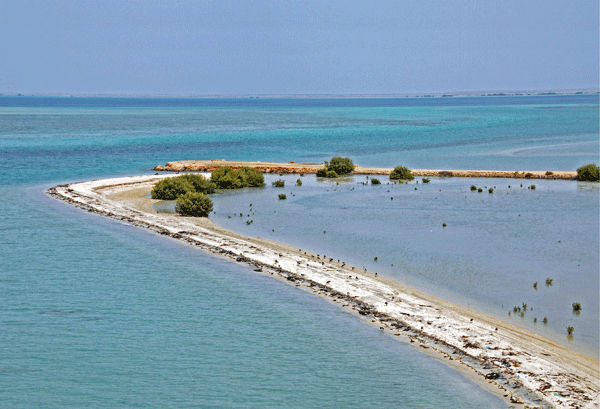
As such, the presence of reef together with a mix of flora and fauna makes the Farasan Island one of the most attractive and popular spots in Saudi Arabia. Morever, Farasan Island is also a diving spot besides being a favorite destination for Saudis, expatriates and international visitors. The Farasan Island today is a large archipelago of Red Sea coral islands with many low-lying islands and islets surrounded by blue water and virgin greenery well manicured by nature.
Some smaller islands are bare and surrounded by coral, while others are sandy. The largest island is Farasan Kabir, being 66 kilometers long and 5 to 8 km wide, and the highest point does not exceed 72 meters. It has the greatest biological diversity. Getting to Farasan Island is easy and enjoyable. The nearest airport is located in the far south-west port city of Jizan servicing flights from all key cities in the Kingdom. From Jizan, modern ferry services routinely go to Farasan Island.
The Jizan Harbor is a picturesque site complete with the old traditional wooden fishing boats called dhows. A large number of traditionally decorated dhows are in use today. In fact, Farasan Islands is a group of 84 islands (archipelago) in the Red Sea with its main island named as Farasan or called Farasan town. All along the short radius of Farasan, a number of uninhabited islands serve as breeding sites for large number of birds.
In addition to it, Farasan serves as a natural reserve for Arabian gazelles. Though not a green island, it has beautiful coastlines to spend silent hours and rich marine fauna to quench the thirst of a sea diver or a nature lover. About 160 nautical miles (298 km) southwest of Farasan island, there lies the Eritrean port of Massawa. No doubt, Farasan, the main island, makes a great break from the mainland for one big reason – fabulous diving.
The area is just bursting with marine life and diving is superb in the shallow, plankton-rich waters. The islands also have some of the few remaining coastal mangroves and endangered dugongs in the Red Sea. The town of Farasan has several traditional houses built from coral with intricately decorated and carved doorways. These were the homes of former merchants and pearl dealers. A small Turkish fort sits on the edge of town.
The Seaport Authority issues tickets for the two ferries and if you’re coming with a car, it’s best to reserve two days in advance. While ferrying to Farasan, a few islets can also be seen during your journey. Some of the islands are just bare rocks while some are sandy and surrounded by corals. The sea is normally silent. Farasan Island’s great biological diversity attracts nature lovers from around the world.
With underwater photographic equipment, you could have great opportunity in copying and capturing rich Red Sea treasures of Farasan. On the other side, banks of Farasan Islands have had rich growth of coral reefs due to vast areas of shallow water. Farasan banks offer unrivaled opportunities for skin diving and snorkeling. It is one of the most attractive and popular diving spots in Saudi Arabia.
In addition, the Farasan Island is home to the special nature reserve; which was established in 1989. It is mandated and supervised by the Riyadh-based National Commission for Wildlife Conservation and Development (NCWCD). As a result of the protected status of the nature reserve, the Farasan Island now holds the largest gazelle population in Saudi Arabia. In fact, o n the main island there are more than 500 gazelles which roam freely.
Can you imagine the photo opportunities on the island? Moreover, the island is very rich in flora and fauna of its own. Fauna of the Farasan Island include 231 species of fish, 49 species of reef building coral, three species of Dolphin, wide diversity of molluscus, crustaceans, large numbers of breeding seabirds as well as populations of breeding Ospreys Pandion haliaetus and Sooty Falcons Falco concolor.
A remnant population of endangered Dugong dugon and the only known confirmed breeding site for Crab Plover on the red sea coast are protected on Farasan. Besides, there are many more to see on the island. And for those who enjoy history, a smaller island not far from the main Farasan Island holds the ruins of an old German-built Fort used during World War II. It is said that this fort had been a secret storage location for ammunition during the war.
The studies on the flora of Farasan archipelago and various plant communities are of great significance in scientific research as the species occur in an independent environment, where influences from other similar communities found in the mainland are almost nil. The smaller islands around Farasan also play an important role for migratory birds as a nesting place and for developing a conduce environment for a number of endemic races of snakes.
However, the first and foremost important factor that makes Farasan group of islands unique is the presence of two important Mangrove populations, Avicennia marina and Rhizophora mucronata. These species are ecologically important and highly productive littoral biotopes and are acting as a reservoir and refuge for many small animals, birds and fish.
The pneumatophores that grow erect above water are an ideal site for the breeding of a number of fish, particularly of shrimps, prawns and crabs. Both species share the same shore-line habitat and seen growing side by side. The southeastern area of Farasan, where the land is rugged, contains the highest number of plant species; whereas the northwestern unbroken plateau and the western facing shoreline are devoid of plants except for a few species.
The overall vegetation of Farasan Islands is interesting in two aspects—firstly because of its similarity to the distribution of natural plant communities and secondly its similarity to the floral elements of the Tihama region of the southwestern region of mainland Saudi Arabia. The plant communities at the south eastern part of the island, where the density of the vegetation is noticeably high, are dominated by small trees and shrubs.
Sasid (Sajid or Saqid) Island, the second largest island in the archipelago is also an open flat reef with shallow wadis. Vegetation of this island is dominated by halophytic communities such as Limonium axillare, Suaeda monoica and occasional trees such as Hyphaene thebaica. Abandoned agriculture lands are a common sight on this island especially near old dwellings. Topographies of other islands are more or less similar to the two major islands.
The vegetation of Dawshak and Dumsuq islands are also more or less similar to other smaller islands. The Saudi government is working closely with public and private sector organizations to further develop the facilities at a cluster of islands on Farasan. In fact, a total of SR460 million was allocated late last year to develop the island as an attractive tourist destination. The plan is to convert the Farasan islands into a national tourist destination for environmental tourism.