The Holy Journey to
Makkah
 |
Ghazanfar Ali Khan
The Hajj, or pilgrimage to the holy city of Makkah in Saudi Arabia,
is a mandatory duty of Islam, which brings together Muslims of all races and tongues for one of the life’s most moving spiritual experiences.
For centuries, countless millions of Muslims, men and women from the four corners of the earth, have made the pilgrimage—a religious duty essential for all adult Muslims, who are physically and financially capable of undertaking the journey.
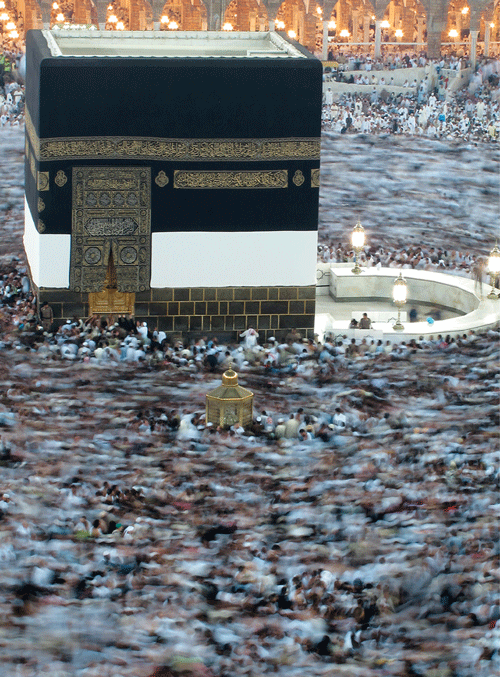
In carrying out this obligation, they fulfill one of the five pillars of Islam, which demonstrates the solidarity of Muslims and their submission to God. No doubt, the annual Hajjj pilgrimage is among the largest mass gatherings in the world today. It draws more than three million Muslims from every nook and corner of the globe. Handling a crowd of that magnitude hasn’t always been easy, especially in the light of public health worries and growing security fears now-a-days.
Making necessary arrangements each year for the growing number of pilgrims pose a real logistic challenge for the Kingdom, which has, since 1950s spent more than $125 billion to expand pilgrimage facilities. But, Saudi Arabia always accepts and addresses the challenge satisfactorily. This year also, the Kingdom and its government agencies have geared themselves well to ensure peace and security during Hajjj.
And to ensure such a feat goes off with minimal disruption, Saudi Arabia’s authorities have gone high-tech. The Saudi government uses live crowd analytics software CrowdVision to manage the throng. This software spots patterns of crowd behavior that indicate potential danger such as high densities, pressure, turbulence, stop-and-go waves and other anomalies. Back in a central control room, police and military personnel monitor the live data feeds provided by the software, which lets them see in real-time where the crowds are thickest.
The whole high-tech system is further backed by several battalions of security forces, doctors, paramedical staff and volunteers; who are stationed on high alert round-the-clock during the Hajj period. On the other hand, transporting two million people at once has the potential of setting new records in gridlock. To combat this, authorities will employ 15,000 public buses employ to help move the masses between the holy sites.
Like the crowds, the buses’ movements are also tracked by wireless monitors to help authorities grasp where traffic jams hold up the procession, and make adjustments accordingly. The government has also invested in several long-term public transport initiatives to take some pressure off the roads. The Al Mashaaer Al Mugaddassah Metro was completed in 2011, and ferries pilgrims between Makkah, Mount Arafat, Muzdalifah and Mena-all required stops on the Hajj. The railway line was designed to shuttle 72,000 passengers an hour.
On health front, the Kingdom has also geared itself well. While various health crises-namely MERS and Ebola-have cast a shadow over this year’s proceedings, organizers have employed a medical army to address any health issues that might arise. According to the Ministry of Health and the WHO, this year there will be hundreds of ambulances on standby, as well as 22,000 health care professionals, 141 health centers, and 25 hospitals.
About two million meningitis vaccines have also been distributed among health centers in 20 governorates and provinces across the Kingdom for domestic Hajj pilgrims. It is mandatory for all pilgrims to be vaccinated against meningitis and for those coming from abroad to be vaccinated against meningitis as well as other contagious diseases. This helps to contain and kill the virus of the contagious diseases, which may spread in crowds.
To safeguard against the possibility of attacks or security breach, the Saudi security officials have installed thousands of CCTV cameras throughout the holy cities, focusing on the holy sites, and employed facial recognition technology. They have also decided to deploy about 100,000 security troops in Makkah including Mena, Arafat and Muzdalifah to ensure the safety of pilgrims and enable them to perform their rites with ease and comfort.
In fact, this year’s Hajj will be a rewarding experience for pilgrims, who have already started flocking to the two holy cities. Pilgrims for this year’s Hajj could look forward to all the facilities ranging from travel, food and accommodation to performing prayers and rituals at the pilgrimage sites. The Saudi Ministry of Hajj and Endowments has deployed thousands of volunteers, who will be working in shifts to assist and guide pilgrims in holy cities and the surrounding areas.
A public transport system has been put in place also by the Ministry of Transport. The buses transporting the pilgrims should not be older than 2006 models. Service providers should serve dry meals to pilgrims in Muzdalifah, where they halt overnight before proceeding to Mena and Makkah. They will also assist lost pilgrims, especially the elderly, in reaching their destinations. They will provide wheel chairs and offer to carry the sick and elderly to the Haram to perform the Tawaf-e-Ziyarah and Saee.
As for women performing Hajj, the ministry is extending to them services of female guides. They are engaged in doing the noble service that they have inherited through the ages. A woman guide is either the daughter or sister of a male guide. She was brought up with adequate training to serve the woman pilgrims and the visitors, says Yousuf bin Ahmad Hawala, chairman of the board of directors of the National Organization for Pilgrims’ Guides in Madinah.
The duties of female guides include receiving woman pilgrims, accommodating them, preparing food and arranging whatever they need during their stay in Madinah. They also take care of sick pilgrims, helping them to perform the pilgrimage rites correctly before leaving the city. Then, there are arrangements made for disabled persons, who come from different countries to perform Hajj.
This year, the Ministry of Municipal and Rural Affairs will provide a large number of electric wheelchairs for use at the Jamrat (stoning area) and its vicinity to facilitate the Hajj rituals through safe and easy mobility. These wheelchairs will serve more than 70,000 disabled pilgrims in addition to their companions, which takes the number to 200,000.
The number of chairs were increased following the allocation of three more paths in addition to the existing five leading to the bottom of Mount Arafat. To this end, it must be noted that two more paths had been added to the pedestrian area in Aziziyah in Makkah, while an additional 50 carriers had been provided to further facilitate the disabled pilgrims.
Whatever, the case may be, but the task to make arrangements for pilgrims is increasingly becoming difficult keeping in view the fact that there has been a substantial increase in the number of pilgrims during the last 100 years. Apart from domestic pilgrims, who travel from various cities and villages of the Kingdom for Hajj, the number of foreign pilgrims has increased by approximately 2,824 percent, from 58,584 in 1920 to 1,712,962 in 2012.
In 2013, the pilgrims quota of various countries were reduced because of the major expansion projects undertaken by the Kingdom in the two holy cities. In fact, Saudi government spends billions of riyals to make the Hajj as smooth as it can be. But, Hajj is becoming a very difficult challenge for the Kingdom. This is why the government doesn’t spare any effort to help the pilgrims fulfill the obligation of the Hajj, which is called the fifth pillar of Islam.
In Hajj every year, the Saudi leaders also host a large number of pilgrims on their own exception. This year also is no exception. Custodian of the Two Holy Mosques King Salman will be hosting thousands of Muslims from places where it is difficult for people to perform Hajj for any reason. Their entire trip will be paid by the king. Saudi Arabia has made arrangements for receiving the foreign pilgrims.
The King Abdul Aziz International Airport in Jeddah and Prince Mohammed Bin Abdulaziz Aiport in Medinah have now dedicated pilgrim terminals to assist the arrival of pilgrims. During Hajj, several airlines including Saudia—the national carrier of the Kingdom, have been authorized to run extra flights to accommodate the large number of foreign pilgrims. Since the pilgrims’ number has been progressively growing, the Saudi government agencies have adopted several crowd-control techniques to ensure safety.
Also, the large pillars symbolizing satans used in the pebble throwing were changed to long walls with basins below to catch the stones for safety reasons. Another example is that the animal slaughter can now be done by appointing someone else to do it. The local banks have been also authorized to facilitate animal slaughtering, which is an important Hajj ritual mandatory for every pilgrim.
Undoubtedly, Saudi Arabia has geared itself well to cope with any emergency situation now or in years to come. But, the challenges ahead are more complex as the number of pilgrims arriving for Hajj and umrah is growing progressively. According to studies conducted by the Hajj Ministry, demand for transporting Hajj pilgrims is expected to double over the next 25 years, while Umrah pilgrims will total 11 million.
To this end, it is important to note that a full-fledged pilgrim city has come up along the Jeddah-Makkah Expressway. It will be a smart city equipped with the most advanced facilities and systems. This city was planned to reduce congestion in areas around the Grand Mosque. It will have government department offices, residential buildings, health facilities, Tawafa, Zamzam and transport offices, shopping and exhibitions centers, mosques and a Hajj museum.